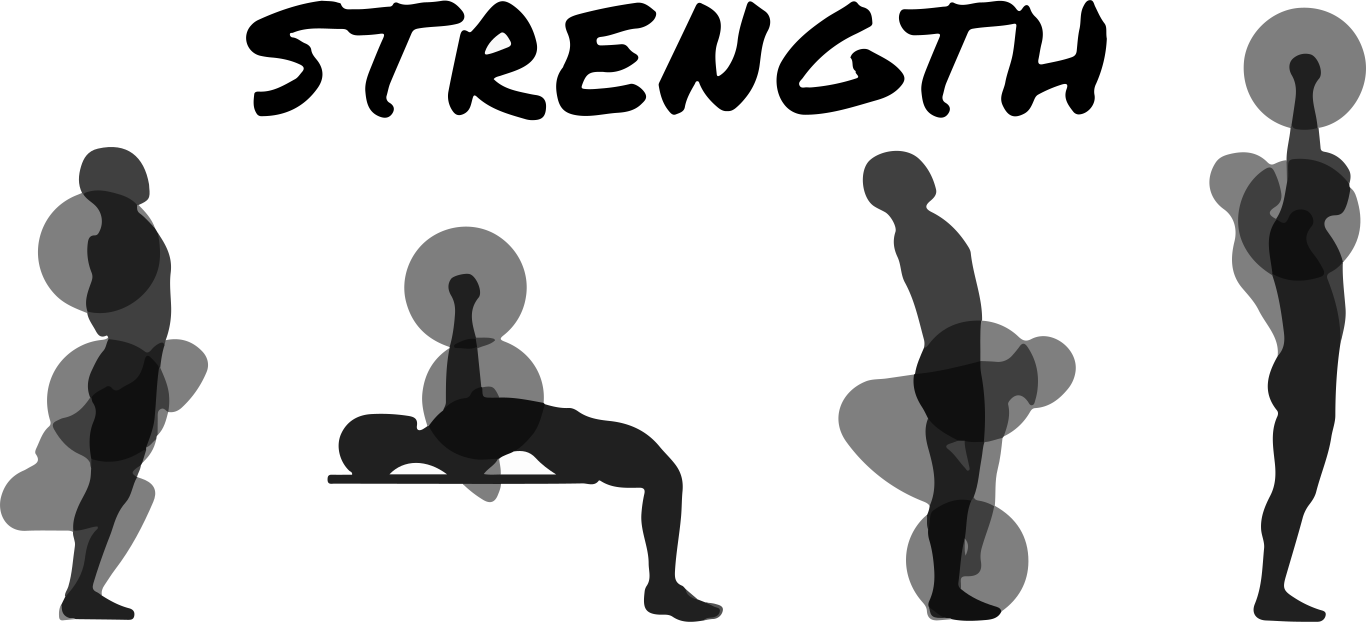
SQUAT
BENCH PRESS
DEADLIFT
PRESS
WHY STRENGTH?
The production of force against an external resistance is the way all living creatures interact with their physical environment… This ability has been in development for at least 3 billion years, and it’s time to embrace it as a unifying characteristic of life. Even the tiniest scrap of your successful physical existence is predicated upon your ability to move, and this ability is predicated on the production of force by your muscles. I’m sorry to be so blatantly reductionist, but there it is.
Above is a quote from a Starting Strength article by Mark Rippetoe called Strength and its Derivatives, if I could state it any clearer, I would (go read this article).
The necessity of strength. in the game of golf, is commonly questioned and occasionally demonized. Strength also gets a lot of praise in the game of golf, as long as its “natural” and no one is lifting heavy weights.
For as long as golf has existed suppleness or mobility have been the most highly touted physical attributes. It’s common to hear you must be smooth, relaxed, limber and all the other ways you can say “flexible”. However, there’s one major conflict to this idea, the best of the best are also the strongest, they always have been.
Nicklaus, Langer, Norman, Woods, Els, Duval, Singh, Westwood, Kaymer, McIlroy, Scott, Day, Johnson and Koepka all have incredibly different swings but they all have two things in common; each has been the best player in the world and they all were/are stronger than the average tour player. These players are great for many reasons, mostly because they are incredibly skilled, but so is every other player on tour and the women of the LPGA Tour are incredibly skilled yet none of them have had any success on the PGA Tour for the same reason. Strength is the ability to produce force and force is the quantity that produces acceleration, this equates to speed and distance even with an implement as light as a golf club. Strength is a major factor in performance. If skill is equal, the strongest player will have the advantage.
Now, no two people are equally skilled, there are far too many variables for anyone to be exactly as skilled as anyone else, so why does it matter? It matters because YOU have the same level of skill as YOU. A stronger you is a better you. Strength does not take away from anything; not from skill, touch, speed, flexibility, balance, knowledge, focus, endurance or any skill required for golf, strength supports every skill. Strength isn’t just an attribute, it’s the greatest attribute. Strength is the most general physical adaptation you can make and it’s simple, although, not easy.
The
4
Main Lifts
The Squat, Bench Press, Deadlift and Press are the only four lifts you will need to make your entire body STRONG. You may decide to add accessory movements into your program, but these four movements are the key to building total body strength. Improving total body strength requires a very simple program. The beauty of the Linear Progression Strength Training program is in the simplicity, a simple program eliminates excess variables that can keep you from seeing what is most important, PROGRESS.
Progress is why you’re here; progress is what keeps you coming back, progress is what makes all the effort worthwhile, progress is IMPROVEMENT. When you improve these four lifts, you get STRONGER. You don’t just get better at the squat, bench press, deadlift and press, you get better at everything.
The Squat is considered the KING of exercises, and for good reason, the squat is the only exercise that allows direct training of the movement pattern known as HIP DRIVE– this movement increases utilizes the entirety of the posterior chain, the hip extensors. The extension of the hip joint is the most powerful movement we are capable of producing with our human anatomy.
Strength is the ability to produce force, and force is how we, as humans, interact with our environment. We push and pull on things. Pushing and pulling on something is the only way to actually get anything done. As I’m typing this I’m pushing on the keys of my keyboard, clicking my mouse, pushing on the floor to rock back and forth in my chair. Turning my head left and right requires muscular force, the muscles inside my neck and upper back pull against tendons, which in turn pull on my skeletal system to turn my neck. This does not require a large amount of muscular strength, but it does require some muscular strength.
There is one very important thing to know about our skeletal muscles, they only actively do one thing. Contract. When a muscle is bigger and stronger it is better at contracting, that’s it. A muscle does not get stronger specifically for turning your hips through the golf swing, all the muscles that contract and relax to create the turning motion get stronger and then they can contract harder or faster to create more or faster hip turn (or any other movement). Your muscles don’t know they are turning your hips, they simply receive as impulse from your brain to contract.
This brings me to a second important point which seems to befuddle the talking heads of the golf world. When muscular strength, size and capacity for maximal contraction is increased the lightest end of muscular contraction does not go away. What does this mean? A man who is capable of deadlifting 800lbs off the floor is also capable of squeezing a tube of toothpaste with just the right amount of force to get just the right amount of toothpaste on to his toothbrush.
Think about how stupid this is for a second. If strong people became incapable of producing low amounts of force with any amount of control, they’d flex their bicep to get their fork to their mouth and impale themselves. They couldn’t draw a picture without snapping a pencil and stabbing it through the canvas. They couldn’t drive a car or change a baby’s diaper without certain catastrophe.
The idea that golfers “lose touch” or “feel” when they get big and strong is absolutely moronic. Brooks Koepka went from a skinny kid on the Challenge Tour (the European Tour’s version of the Korn Ferry Tour), gained twenty pounds and rocketed to world number one. It’s not possible that Brooks lost touch and became a better golfer, but it is very clear that he gained strength and became a better golfer.
Now that you know stronger doesn’t make you HULK SMASH everything in sight, consider the golf swing. It begins with our feet on the ground, as do most sporting actions. The feet are the only point of contact with anything, other than the grip (we’ll get there), as the first point of contact they are crucial for balance. The muscles within the foot and toes are constantly keeping you in check as your weight shifts throughout the swing, this is all force application. The muscles in your legs flex and extend the knee and ankle joints, pushing off the ground and transferring force to your hips, torso, shoulders, arms and eventually to your hands. The entire journey is made up of muscles contracting and relaxing. The stronger those muscles are, the more force you will be able to apply to your only other point of contact, the grip.
The muscles of the fingers, hands, wrists and forearms make it possible for you to hold on to the golf club. They may also be the most important muscle groups in the golf swing as they make thousands of micro adjustments constantly throughout the swing, and you’re likely not even aware of it. Those micro movements still require muscle contraction.
When muscles are capable of contracting harder, they simply have the OPTION to produce more force if necessary, they are not required to produce all potential force.
Try this: stand on one foot and shift your weight around, notice the wobbling? That is just slightly larger micro adjustments to keep your center of mass over the middle part of your foot. Lean forward and your leg will instinctively move backward. But, if you’re too slow or you can’t apply enough force through the front of your foot while you’re finding your center, you’ll fall on your face. The inability to apply enough force (weakness) is the reason old people have walkers and handrails to get up off the toilet.
Have I beat this point to death yet? STRONGER IS BETTER. Got it?
Okay, stronger is better, but how are four exercises going to strengthen all those muscles used in the golf swing? The deadlift, bench press, squat and press movements have been chosen because they use the greatest amount of muscle mass to move the greatest amount of weight over the longest effective range of motion.
I didn’t choose these exercises, while I have some experience, I defer to the experts whenever I can. This will not be the first time in the BLACK IRON GOLF programs when I will defer to someone who has spent much more time on a given subject than I could ever dream.
Mark Rippetoe, founder of Starting Strength, is the expert for this program. Mark has decades of experience making people stronger and has written a few books on the subject. I highly recommend you check out startingstrength.com, the podcasts, the books and anything else he has ever said, written or belched on the subject of strength training. You might notice there is one more lift, the power clean, in the Starting Strength program. If for some reason Mark ever reads this, he’ll probably yell at me because, “If you’re not doing the power clean, you’re not doing the program.” And he’d be correct. The reason I leave the power clean out of this program is because it is more difficult to learn on your own. If you want to add the power clean please do, it’s a tremendously valuable movement, but get proper coaching. You can find starting strength coaches online to help you through any of the lifts.
You can, and will, get very strong if you only perform the 4 main lifts and follow the program. The simplicity of this program is the key. You want to get better at golf and getting better at golf requires a lot of time, so this program is built to be as economical as possible with time spent in the gym. In just three hours a week you can get stronger than you’ve ever been in your life. The program is NOT EASY but it is SIMPLE.
The Linear Progressive Strength Training (LPST) Program is as follows:
Workout A
Squat 3×5
Bench Press 3×5
Deadlift 1×5
Workout B
Squat 3×5
Press 3×5
Deadlift 1×5
Your week will go ABA, like this:
Monday: Workout A
Tuesday: Rest
Wednesday: Workout B
Thursday: Rest
Friday: Workout A
Saturday/Sunday: Rest
The following week will switch to BAB and you’ll alternate each week, so you never have two A or two B workouts in a row.
You might be tempted to add accessory lifts or some cardio (we’ll talk about that later), as this doesn’t seem like much at first, but please hold off, there will be time. After two weeks of this the LPST program modifies slightly and you drop the Wednesday Deadlift, as the workload will be too much to recover properly. At this point you can add an accessory exercise like Bent Over Rows, if you’d like, but it’s up to you.
Around weeks 4-6 you’ll probably notice you cannot continue to add weight to the Friday deadlift. You can drop the Friday deadlift and add another accessory lift like Chin Ups if you want.
This is called the Linear Progression Strength Training program for a reason. Those words are very specific, lets go backwards. The act of training is preparing for something that requires more of you, requires you to be better at some point in the future. This program is training for strength. Strength, as we beat to death earlier, is the ability to produce muscular force. If you can produce enough force to lift a 400lb barbell, you are stronger than someone who can only lift a 300lb barbell. Progression is simply the process of moving gradually towards a more advanced state (improvement). Linear refers to your charted progress. It is difficult to improve linearly in most things, that’s the beauty of this program, you will see tangible improvement at every workout. Improvement does not mean easier. Improvement means the weight is going up, AT EVERY WORKOUT.
Let’s get to the weight, reps and sets.
Your first workout is going to set the stage for your program. It doesn’t matter if you’ve worked out a lot in the past, everyone should begin the same way. You must learn the lifts (click here) so the LPST program can be as effective as possible. After you have learned the lifts, your first workout will begin as all other workouts, with the squat and an empty bar. Set up to the bar properly with the bar in the low-bar position, heels shoulder width apart, toes flared out about 30 degrees and perform FIVE full reps. Rack the bar. This might be the most weight you can do, but probably not. If the weight was very easy add 20lbs (10lbs on each side) to the bar. If the weight was manageable but a little heavy, add 10lbs total. And if you’re not sure if you can add more weight, add 5lbs and give it a try. Perform 5 more reps. Continue this process until the reps slow or you feel like you can’t add any more weight. (DO NOT just start with a weight you know you’ve lifted before, if you know you can squat 225lbs you should still begin with the empty bar and build up slowly. You’ll likely fatigue before you get to your PR, that’s fine.) Once you’ve reached what you feel to be your limit, make note of the weight. We’re done squatting for the day. Perform this same routine with the bench press and the deadlift. With the deadlift, if you do not have light bumper plates or cannot deadlift 135lbs, you will want to elevate the bar to the same starting position as it would be with 45lb plates.
The second workout will be a little different. You need to know your training load. Your training load is 5lbs more than the previous workout. If you stopped at 80lbs, your training load is 85lbs. IF you stopped at 135lbs, your training load is 140lbs, etc. We’ll use 105 as our training load example. You will begin with 2 sets, 5 reps each, of empty bar squats (45lbs) as a warm up, add 1/3 (20lbs) of your additional training load (the bar is 45lbs your training load is 105lbs, the additional training load is 60lbs) and perform 5 more reps, add another 1/3 (20 more pounds) and perform 3 reps, add the final 1/3 (20lbs) to get you to your training load of 105lbs (5 more than Monday) and perform 3 sets of 5 reps. Be sure to fully recover between sets. Full recovery could take 3-5 minutes at this point. Later it could be up to 10 minutes.
Notes: If your weight from the first workout was under about 80lbs you might want to warm up with body weight squats.
The division of the warmup reps does not have to be perfect, close is fine. They’re not maximal lifts so it’s not vital. If you want an easy calculator you can download the Starting Strength app
Your next exercise will be the Press. Since the bench press and the press alternate, and you have not performed the press yet, you will follow the protocols used on the first day with the squat, bench press and deadlift. The press is often the lightest lift for many people, so you may just begin with an empty bar.
Finally, you will deadlift. You will probably be able to add 10lbs to your deadlift at each workout for a time. If you can, you should. You will be loose from the squat and the press, but a few warmup reps aren’t a bad idea to practice form. Remember the deadlift is 1 set of 5 reps.
You’re done.
For Friday’s workout you will add 5 more pounds to your squat from Wednesday, 5 more pounds to your bench press from Monday and 10 more pounds to your deadlift from Wednesday.
This continues for about two weeks or until the deadlift becomes too heavy to perform three times each week. You may add an accessory like Bent Over Rows or Chin Ups to Wednesday.
This continues for a couple more weeks until you can only deadlift on Monday, at which point you can add an accessory to Friday. Do your main lifts first, accessories are accessories.
Pay careful attention to your recovery because around weeks 6-8 this will begin to get hard(er). This is not quitting time; this is work harder time. If you’re eating and recovering properly you should be able to run this program for 12 weeks, longer if you’re a young man. You’ll be lifting more weight than you ever have and maybe more than you ever thought you would. You will probably begin to struggle on the press and maybe the bench press, at which point you can make one of two adjustments. If you have micro plates (make some here), I suggest you use those and add weight in 2.5lb increments (this is still progression). Or continue to add 5lbs and change to 5 sets of 3 reps. There might come a point when you must decrease micro plates to 1lb increments and/or use 5 sets of 3 with micro loads. Those are the recommended ways to continue your LPST program as long as possible. You want to continue as long as possible, there is nothing better than steady improvement. Progression will become more difficult and less linear; you don’t want to rush to this point, it’s less fun.
You’ll probably get to a point you think is “strong enough”. I do believe any amount of stronger is some amount of better, but you want to get better at golf, not weightlifting. I know. If you can deadlift 405, squat 315, bench press 225 and press 155. You will be a VERY strong golfer. I wouldn’t recommend pursuing greater levels of strength if training time and recovery hinder your ability to practice golf. You should, however, still give 3 hours/week to strength training, even if progress has slowed considerably.
Things you’ll notice:
The First Week: You start off day one excited, day two you’re sore. This sucks. Day three you’re sore AND you’ve got to squat again!? Oh, no. Squat anyway, it will make you feel better, I promise. But what about golf, I can’t golf when I’m this sore. It will go away. Most people are not sore after the first week.
The Second Week: Hey, you’re not sore anymore. Told ya. This still sucks but I kind of like it. After this week Wednesday deadlifts might have to go away.
The Third Week: You’ll begin to notice a little bit of changing body composition. If you are a skinny person you’ll notice the muscles around your knees changing. Your chest and shoulders will begin to show, and your pants might fit a little better because what’s that behind you? An ass! (I was a long-time sufferer in the no-ass club). If you are slightly overweight you may or may not see the changes as easily but your pants will begin to fit a little more loosely.
The Fourth Week: Some things are getting harder. Deadlifts might only be on Monday now the press might start to get heavy. Before you begin to back off the increases on the press, take a look at your recovery. Make sure you’re doing everything you can to help build new muscle. Sleep at least 8 hours each night. Eat at least 1g of protein per pound of bodyweight. And, if you started underweight, eat at least 4,000 calories each day.
Hey, after this week you will have added 60lbs to your squat, 30lbs to your bench press, 30lbs to your press and up to 100lbs to your deadlift. THAT’S AWESOME.
Weeks 5-10: These weeks are hard, but worth it. Keep eating, keep grinding out reps and watch the weight on the bar keep going up. Another PR every day! You may have stalled with a lift or two once or twice. If you failed to get all 3 sets of 5 reps, repeat the training weight the next time you have that exercise. You should notice a bigger change in body comp now. Take this time to pay close attention to your diet.
Week 12: If you can keep going, KEEP GOING. For some it might be time to be transitioning into a slightly different program. If you have made it to this point there is a good chance this is the hardest thing you have ever done physically, and maybe mentally. If you followed the program to the letter you added 180lbs to your starting squat and deadlift, and 90lbs to your starting bench press and press.
There is an overriding theme through all BLACK IRON GOLF programs. The programs are as pragmatic and straight forward as possible, they are designed specifically to make you better, but improvement is HARD.
If you want easy, go do something else.
The motto of BLACK IRON GOLF is Relentless Pursuit of Improvement. You need to want to get better more than you want to skip a workout or just try that new swing tip from the golf channel. If you follow these programs you will absolutely get better, but you must stick with them.
Oh, one last thing, why no cardio?
This is a STRENGTH program. It is ONLY a strength program. There is a good reason it is only a strength program. Golf is not an endurance sport, golf is 2 seconds of near maximal effort, 5 minutes of rest, 2 seconds of effort, 5 minutes of rest, putting (rest), 5 minutes of rest followed by 2 seconds of near maximal force.